
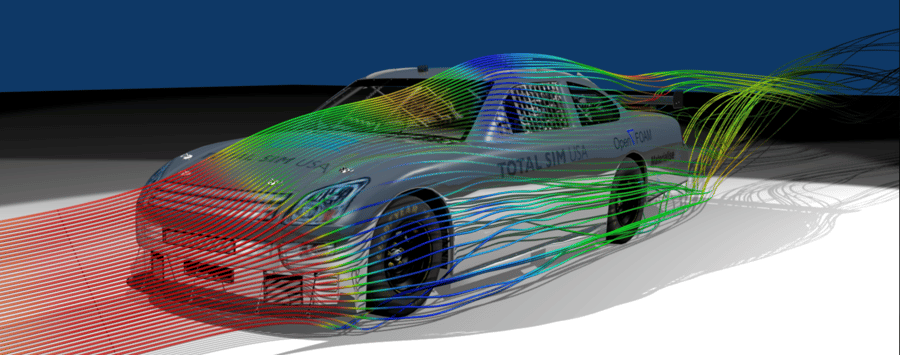
Looking to Accelerate Development and Improve Vehicle Performance?
With TotalSim, you work with a full-service CFD firm here to solve your most complex challenges, using automotive CFD analysis to solve real world problems and outperform the competition.
You gain access to consulting, support, and solutions that help you accelerate R&D & solve your most complex automotive & transportation engineering problems. TotalSim applies its CFD expertise to optimize performance and efficiency — supporting programs from cars to trains across the transportation spectrum.
Benefits & Highlights:
Automotive CFD Analysis for Confident Decisions
Use high-fidelity automotive CFD analysis to conduct detailed aerodynamic evaluation, assess thermal performance, and identify opportunities to improve efficiency early in the design process.
CFD to Optimize Performance and Efficiency
Simulation enables you to apply CFD to optimize performance, reduce drag, improve cooling, and refine vehicle systems before committing to physical prototypes.
Advanced CFD Integrated with Automotive Physical Testing
Combine CFD with automotive physical testing, you validate results, reduce risk, and improve correlation — minimizing costly trial-and-error late in development.
CAE Automation for Faster Development Cycles
Through CAE automation, reduce manual effort, increase repeatability, and accelerate iteration — keeping development timelines on track.
Applied CFD Expertise Across Transportation Platforms
Benefit from applied CFD expertise developed across a wide range of applications, from cars to trains, including complex aerodynamic and thermal systems.
Reverse Engineering & More
In addition to forward design, you can leverage simulation for reverse engineering & more, enabling competitive benchmarking and performance comparison.
Relationship-Driven Consulting Focused on Your Goals
A relationship-driven consulting approach ensures solutions align with your engineering priorities, program constraints, and long-term success.
Request more information
.png?width=600&height=200&name=industry%20newsletter%20footer%20%20(2).png "industry newsletter footer (2)")